Multnomah County's projected ongoing General Fund deficit for fiscal year 2028 has more than doubled to $22.9 million, up from $10 million projected last spring, as inflation and rising personnel costs put pressure on the county's finances.
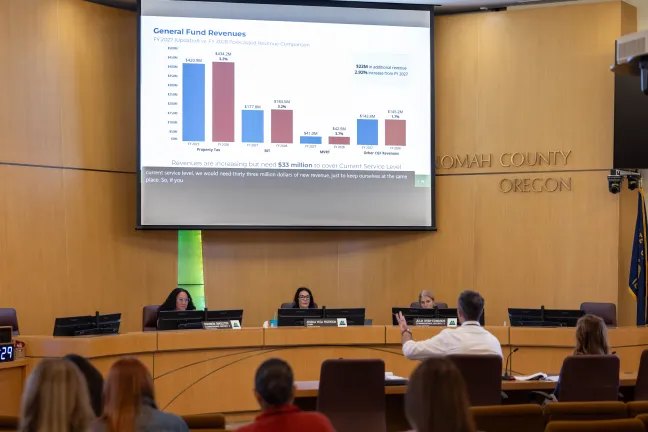
The widening gap was outlined in the county's latest five-year forecast, presented to the Board of Commissioners on Tuesday, Nov. 17. The Central Budget Office projects deficits will continue in future years, reaching $48.4 million in FY 2030 before any reductions are made.
Separately, the county estimates it needs an additional $33 million to maintain its current level of services amid rising costs. That service-level funding need is distinct from the projected $22.9 million deficit.
"Overall, our revenues are increasing, but we are still expecting an increasing deficit in FY 2028," Jeff Renfro, the county's economist, told commissioners.
What's driving the gap
The county attributes the widening deficit to several factors, including energy-driven inflation tied to the Iran War, lower-than-average property tax revenue and federal tax changes.
Nearly 63% of the county's General Fund pays for personnel. Wage increases are tied to regional inflation under existing labor contracts. Earlier this year, the county modeled a 2.75% cost-of-living adjustment for FY 2028. Rising energy prices have since pushed that projected adjustment to 3.90%, adding nearly $7 million in ongoing personnel costs.
"A significant change in our projections on wages leads directly to big changes in our forecast," Renfro said.
Revenue picture is mixed
The county's two primary funding sources — property taxes and business income taxes — are moving in different directions.
Driven by rising U.S. corporate profits, FY 2027 business income tax collections are projected to exceed budget expectations, due in part to a large one-time payment. But federal tax changes under House Resolution 1 are expected to reduce FY 2028 business income tax collections by $5 million, according to the county.
Higher-than-expected business income tax collections are providing a temporary buffer against below-average growth in property tax revenue. Property taxes account for 63% of the county's discretionary General Fund.
The local labor market has settled into what the county described as a "low-hire, low-fire" pattern. Layoffs have slowed, but job losses and rising long-term unemployment continue to weigh on the recovery.
One-time funds offer limited cushion
County departments spent $24.5 million less than projected when FY 2026 books closed. Those unspent funds, combined with business income tax revenue and other adjustments, will give the county $38.45 million in available one-time funds for the coming budget year, according to the forecast.
Under Board policy, half of that amount — about $19.2 million — must go toward facility and IT projects. That leaves roughly $19.2 million for general purposes.
Commissioners will face competing demands for the remaining funds. About $13.7 million in existing one-time programs, including shelter placements, employment services and behavioral health initiatives, are scheduled to expire at the end of FY 2027 unless renewed.
The Budget Office identified lingering inflation, a potential AI-driven market correction affecting corporate profits and the broader business cycle as major risks to the county's financial outlook.
Those factors could affect the forecast before the county chair releases a proposed FY 2028 budget in spring 2027. The county's budget calendar lists a Dec. 2 budget kick-off for county staff.