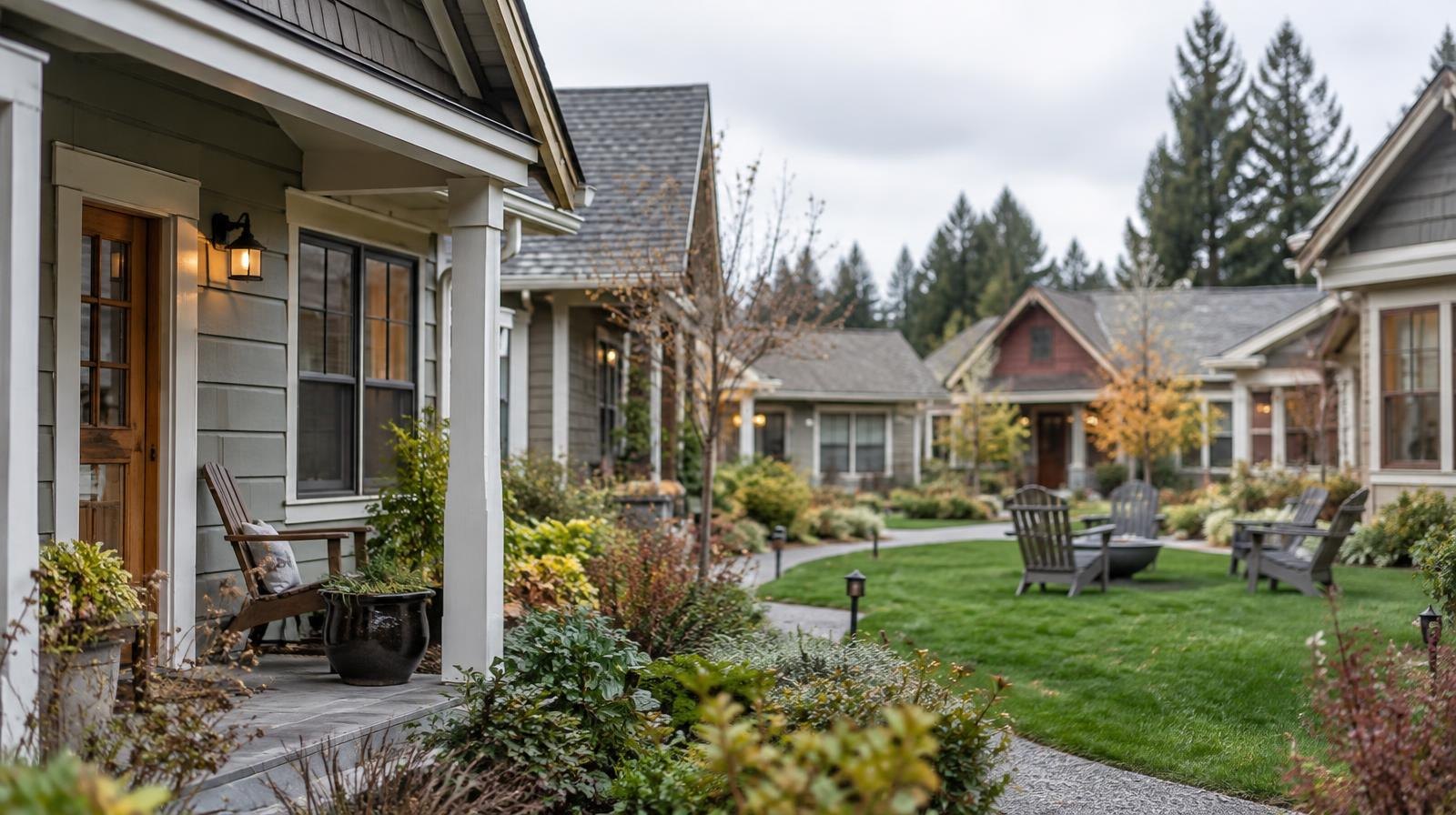
Cottage clusters have become the most popular housing option on single lots in Portland, surpassing conventional single-family houses since the city allowed them in 2023. But a project replacing a 1908 home in Northwest Portland with four units priced at $700,000 to $800,000 each is testing whether the model delivers on its affordability promise.
A Bureau of Planning and Sustainability graph described by the Northwest Examiner shows annual housing construction permits in single-dwelling zones declined from 1,032 in 2018, bottomed out in 2020 and rebounded to more than 700 per year after cottage clusters were allowed.
Those figures cover all single-lot housing permits, not cottage clusters alone. BPS could not provide a count of completed cottage cluster projects but cited four examples in North and Northeast Portland.
Many more are in the application phase.
Cottage clusters are one of several "middle housing" types Portland enabled through its Residential Infill Project, first adopted in 2021 and expanded in 2022.
The rules also allow duplexes, triplexes, fourplexes and accessory dwelling units (ADUs) in most single-dwelling zones.
The city incentivizes clusters by boosting allowable square footage and exempting them from design review if they meet standards, including a 900-square-foot maximum building footprint and at least 750 square feet of common yard.
According to a BPS report published in February 2025, the city permitted over 1,400 ADU and middle housing units between Aug. 1, 2021, and June 30, 2024. The average sales price of a new market-rate middle housing unit in 2023-24 was about $250,000 to $300,000 less than a new market-rate single-family house, mostly due to size differences. That report received the Oregon American Planning Association's Building Tomorrow Today award in September.
A NW Portland test case
The first cottage cluster in Northwest Portland is taking shape at 2857 NW Savier St. A 1908 house is being dismantled to build four three-story homes, each 1,450 square feet, the Northwest Examiner reported.
The latest city definition requires five homes per lot for cottage clusters; it is unclear whether this project was permitted under an earlier standard.
Real estate broker George McCleary, owner of McCleary Realty & Development, told the Northwest Examiner the property owner, HD Clinton of Southeast Portland, bought the lot from the heirs of the woman who had lived in the house for many years before her death.
McCleary said he advised the heirs the rundown house could have drawn a good price as a fixer, but they wanted the higher return the cottage cluster program made possible. The property was listed at $300,000 and sold for $540,000 as a cluster site. McCleary said the target price for each new unit is $700,000 to $800,000.
Two adjacent neighbors objected at the Northwest District Association Planning Committee. Member Joni Johnson said the buildings would consume the lot and that developers made no attempt to match neighboring architecture.
Neighbor Greta Hillbourne said the project does not match the "cottage" label, citing three-story construction, no off-street parking, little storage and concerns about parking impacts.
The 25-foot height limit would not normally allow three stories, but the top floors are measured at the roof's midpoint rather than its peak, the Northwest Examiner reported.
Brokers see promise and limits
Chris Mackovjak, a Realty Portland broker in the Pearl District, lists 17 cottage cluster projects on his website. He wrote that buyers are gaining interest but cautioned that units can feel different in person.
Asked whether cottage clusters are an antidote to the housing shortage, Mackovjak told the Northwest Examiner he would give it a "to be determined."
Darryl Bodie, a broker with Keller Williams Realty who said he has sold over 5,000 Oregon properties in 26 years, said middle housing units can sell for as low as $320,000.
His firm has sold about 500 units per year for three years, with 80% being middle housing. That figure includes duplexes and other configurations, not just cottage clusters.
"We have 200 units available, and there's not a lot of people buying them," Bodie told the Northwest Examiner. "To say that we need more units is nice … but that hasn't necessarily created affordability."