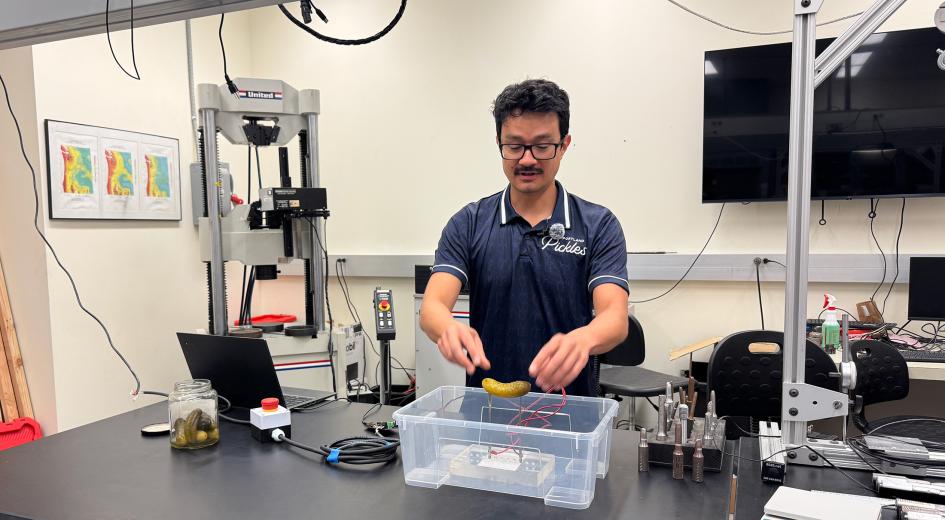
Josh Méndez burned more than 100 pickles in a downtown Portland lab to answer a question that has puzzled researchers since 1989: why does an electrified pickle glow orange?
Méndez, an assistant professor of electrical engineering at Portland State University, found that two competing theories were both partly right. His research, announced by PSU on Wednesday, Sept. 30, concludes that an electrical spark ignites hydrogen gas produced by electrolysis at the pickle's negative electrode. The combination creates the glow.
The debate had split into two camps. One theory held that gas pockets inside the heated pickle stop the current. Brine flows back toward the electrode, and a small arc jumps across the gap. But that theory alone could not explain why the pickle glows at only one end, according to PSU.
A second theory pointed to electrolysis splitting the brine's water into oxygen and hydrogen, with hydrogen forming only at the negative electrode.
"There is hydrogen involved, but it's actually not heat that's igniting it — it's the spark," Méndez said in the PSU announcement. "It's just like why you don't light a cigarette at a gas station."
The orange-yellow color matches the 589-nanometer sodium D-line emission spectrum, the same wavelength produced by sodium-vapor streetlights, as Hoodline reported. Excited sodium ions in the pickle's salty brine produce that signature hue when they return to their ground state.
Pickle the cucumber in a different salt and the color changes. A 2005 Journal of Chemical Education study found lithium chloride produced a pink glow, potassium yielded purple and strontium turned red.
The demonstration traces to an April Fools' Day spoof published by Digital Equipment Corporation on April 1, 1989, titled "Characterization of Organic Illumination Systems." It entered peer-reviewed literature in March 1993 when researchers analyzed the sodium spectrum in electrified dill pickles. The glowing-pickle demo is still used in K-12 science classrooms to teach ionic conduction and atomic emission.
Méndez conducted his experiments in PSU's Maseeh College of Engineering and Computer Science. His broader research covers triboelectricity, volcanic plume lightning and the physics of coffee grinding, according to PSU. The university described the pickle project as an unsolved electrostatics problem that fits naturally within the college's work.
PSU's own language calls the findings "approaching an answer." No peer-reviewed publication date has been announced.