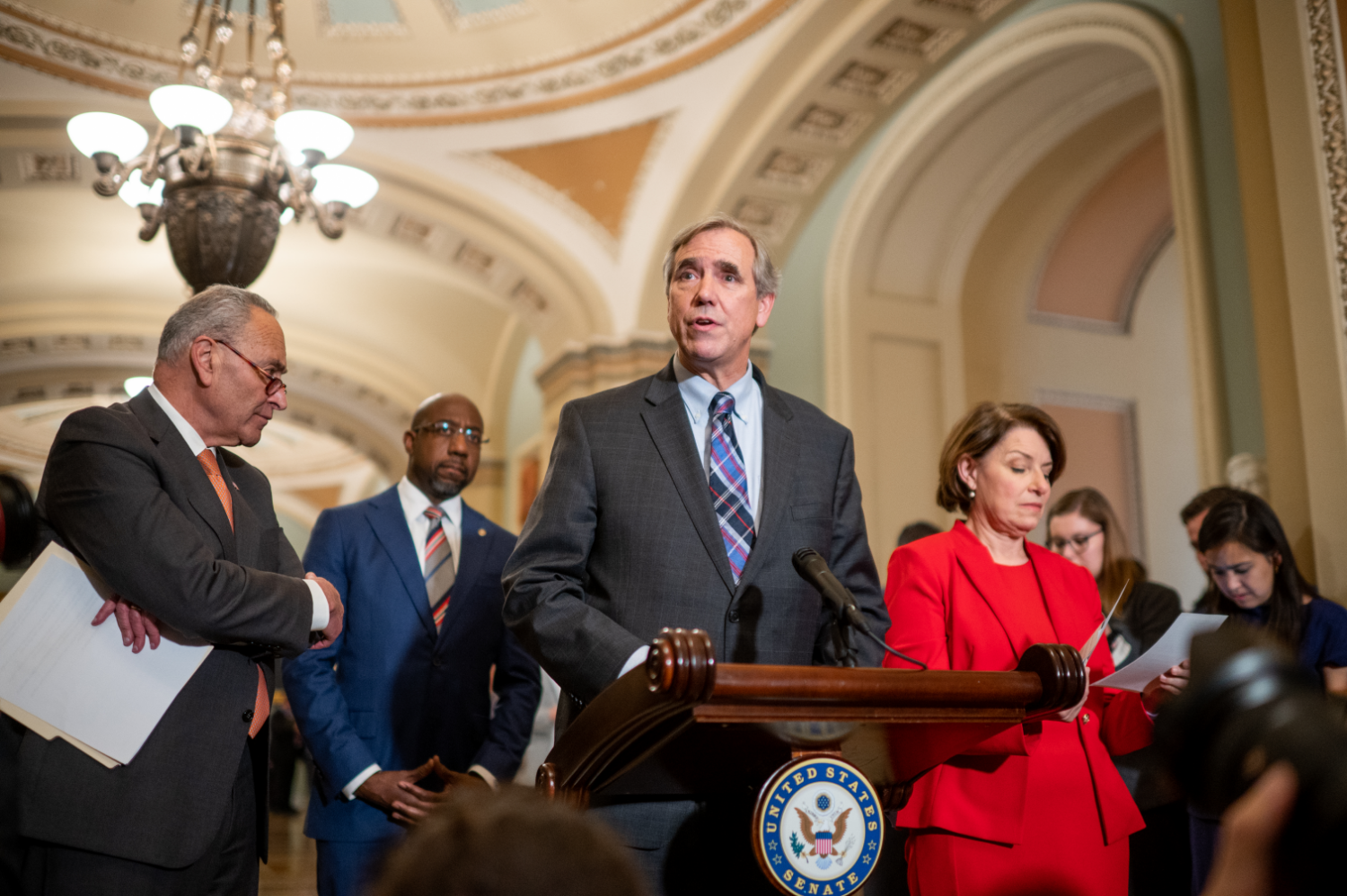
Oregon Sen. Jeff Merkley is co-sponsoring a federal bill that would ban digital price tags in large grocery stores. Walmart says those labels are an efficiency tool that keeps prices low, not a vehicle for charging different shoppers different amounts.
The bill
Merkley and New Mexico Sen. Ben Ray Luján introduced the Stop Price Gouging in Grocery Stores Act in February. The bill would ban the use of personal data to set individualized grocery prices. It would require disclosure of facial recognition technology and ban electronic shelf labels, or ESLs, in stores 10,000 square feet or larger.
Rep. Val Hoyle, a Democrat representing Oregon's 4th District, is a lead sponsor of a companion House version. Hoyle said in March that without proper regulations, corporations would exploit loopholes to raise prices on consumers and called for an outright ban on the labels.
The United Food and Commercial Workers International Union, which represents more than 800,000 grocery workers, has endorsed the legislation.
How ESLs work in stores
Electronic shelf labels replace paper price tags with small digital screens. Walmart is rolling them out to all of its roughly 5,200 U.S. stores by the end of 2026, with about 2,300 locations equipped as of March, CNBC reported.
A typical Walmart store carries more than 120,000 items with thousands of weekly price updates, including rollbacks and temporary discounts. What once took associates days to complete can now be done in minutes, according to Walmart. Amanda Bailey, a Walmart team leader in electronics, told CNBC that the labels cut the time she spent on pricing duties by 75%, freeing her to help customers.
Walmart spokesperson Robyn Babbitt said in an email to Civil Eats in May that the labels "operate on a closed system" and do not collect information from shoppers using cameras or microphones. Prices are set centrally and remain the same for every customer regardless of demand, time of day or who is shopping. Employees push approved changes through a secure system, typically outside shopping hours.
Industry data cited by a Holland & Knight legal analysis shows 92% of ESL price changes occur between 2 and 5 a.m. The remaining 8% are waste-reduction markdowns. ESLs can cut food waste by up to 21%, the analysis found.
Researchers at the University of Texas at Austin, UC San Diego and Northwestern examined more than 180 million product-level observations across 114 stores. The study (available via SSRN) found virtually no surge pricing after ESL adoption. Ioannis Stamatopoulos, a University of Texas at Austin business professor and co-author, told Civil Eats in May: "It seems to me we are talking about banning a technology that can cut costs and potentially reduce food waste based on hypotheticals."
That paper has not been peer-reviewed.
What's next
As of late July, more than 40 surveillance pricing bills were pending across at least 24 states, according to Holland & Knight. New Jersey signed a law on July 23 banning personalized algorithmic pricing in grocery stores and imposing a one-year moratorium on new ESL installations.
The Merkley-Luján bill has not advanced beyond introduction. No committee hearing or vote has been scheduled.