
Portland's youngest students could lose access to classroom screens entirely under a draft policy that all three members of the Portland Public Schools policy committee largely supported at a Tuesday, Sept. 22 meeting.
The draft, developed by the Portland chapter of Schools Beyond Screens, a national coalition to restrict smartphone use, would ban all screen use for kindergarten through second-grade students during the school day.
As Willamette Week first reported, committee members Patte Sullivan, Virginia La Forte and chair Stephanie Engelsman all largely approved of the proposal.
Students in grades 3 through 8 would be limited to using devices only in centralized locations such as computer labs. Time caps would also apply: no more than 20 minutes per day for elementary students, 45 minutes per subject per week for middle schoolers and 60 minutes per subject per week for high schoolers. Exceptions would cover special education students who rely on assistive technology and technology-intensive courses like computer science and graphic design, according to The Oregonian.
"I'm glad that we're here doing this," Engelsman said. "I know the entire board is excited to do something."
The draft goes well beyond PPS's existing cellphone ban, which took effect in 2025 after Gov. Tina Kotek's executive order requiring all Oregon schools to have phone-ban policies by Jan. 1, 2026. The new proposal would extend limits to all devices, restrict apps to district-approved platforms and block access to YouTube, social media and AI chatbots during school hours.
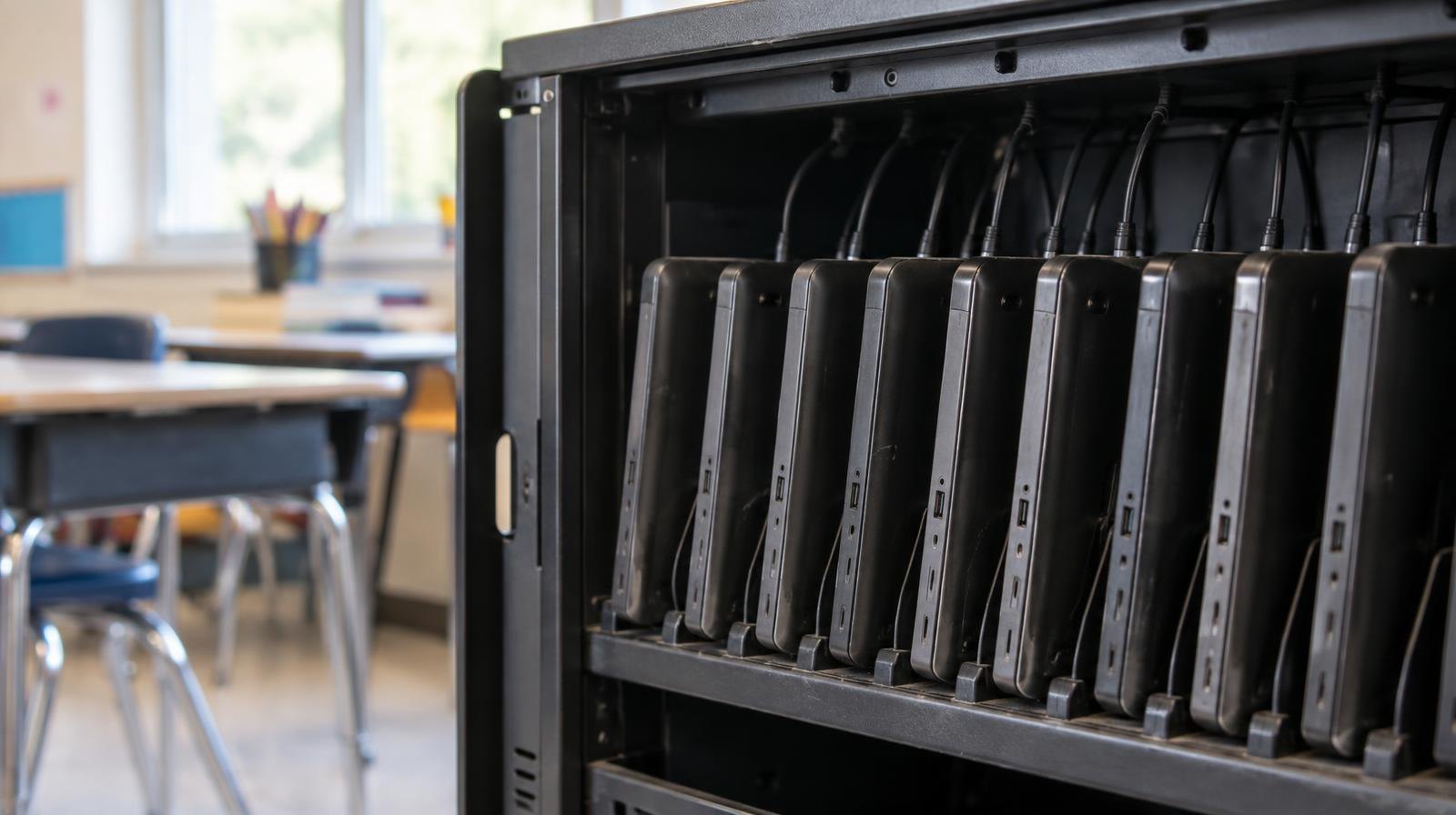
Additional provisions include storing Chromebooks on classroom carts for grades 3 through 8 instead of sending them home, guaranteeing screen-free recess and lunch periods, requiring homework that can be completed with pen and paper whenever possible and banning gamified learning apps.
Schools Beyond Screens Portland was co-founded by PPS parents Miranda Rake and Holly Hofkamp, who surveyed local families and found widespread concern over video use in class, according to Hoodline. Parent feedback indicated technology was often used as a behavioral reward rather than an instructional tool.
District officials said at the Sept. 22 meeting that they had received the draft only the week before and had not completed a detailed review. A more thorough district discussion is scheduled for October. The board's work plan targets a final policy through November.
The committee also discussed developing an AI curriculum for high school students. An AI audit that board members requested in June is expected in October, according to La Forte. The district paused contracting with new educational software that uses generative AI in June while it develops an official policy.
The draft would require PPS to provide the board an annual report on screen time data, platforms in use and any digital or AI curriculum. That accountability measure matters to families: as Willamette Week reported in July, some PPS elementary students were logging up to four hours of screen time per day, far exceeding the district's estimate of about five hours per month.