Melissa Hill left a degree unfinished nearly two decades ago at the University of Oregon.
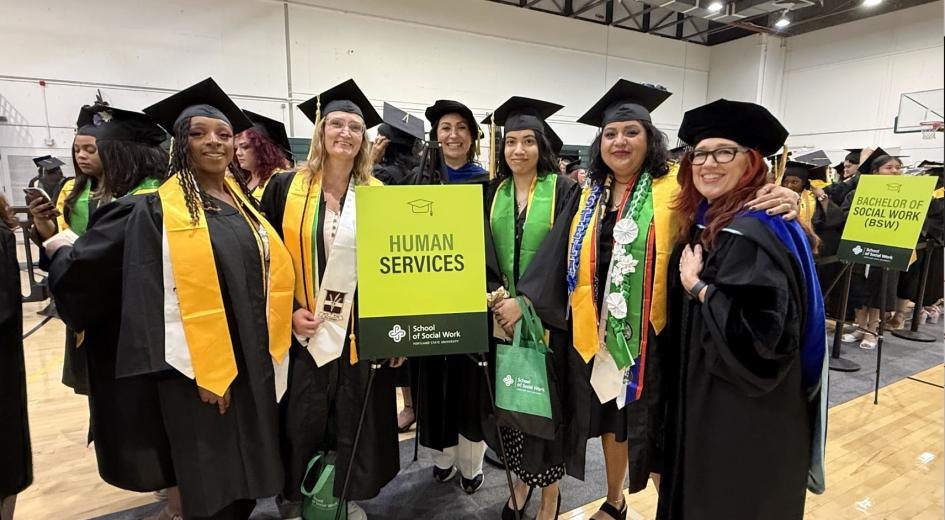
In June, the mother of three who co-owns a dual-diagnosis outpatient program in the Portland metro area walked across the stage as part of Portland State University's first-ever Human Services graduating class.
"There are just too many demands currently on my time and schedule to be able to do anything without that kind of flexibility," Hill said.
The fully online program, housed within Child, Youth and Family Studies in PSU's School of Social Work, serves working adults already employed in social services. Graduates from the inaugural cohort have moved into behavioral health roles across Oregon's social service agencies, according to PSU.
They're entering a field in crisis.
Oregon ranks 42nd out of 51 states and the District of Columbia on an index combining prevalence of mental illness and access to care, according to a December 2025 state workgroup report. The state's Behavioral Health Talent Council found in February that nine out of 14 behavioral health profession types have "alarmingly high turnover risk," with more than two-thirds of workers intending to quit. Addiction counselors face the highest risk at 92%.
The talent council report, commissioned by Gov. Tina Kotek and chaired by First Lady Aimee Kotek Wilson, called for expanding educational pathways and degree-completion programs.
PSU's program answers that call with three flexibility features: credit for prior learning through a portfolio process worth four or eight academic credits, intensive faculty support, and a virtual practicum using trained actors to portray simulated clients in unscripted, high-stakes scenarios.
Fellow graduate Jay Foster, who has applied to work as a victim advocate with the Gresham Police Department, described the practicum as the program's most demanding element. "The simulations were nerve-wracking. No scripts or do overs to fall back on, just testing my skills in real time," Foster said.
Associate professor Tozi Gutierrez, the program's coordinator, said the degree grew from a collaboration between The Partnership @ PSU, the Oregon Higher Education Coordinating Commission and Child, Youth and Family Studies. The curriculum was shaped by workforce surveys and employer input.
As we reported Aug. 6, Oregon remains roughly 27,000 credentials short of its adult degree-attainment goal even as PSU navigates budget cuts. The Human Services program represents one pipeline aimed at closing that gap, with PSU working to align it with National Organization for Human Services standards so graduates can eventually earn a nationally recognized credential.
Locally, the workforce pressure is acute. Multnomah County commissioners in December 2025 approved a $2.4 million emergency budget adjustment to partially fill a $4.6 million gap in behavioral health services after CareOregon ended intensive care coordination agreements.
Without the intervention, the county faced eliminating more than 38 positions. Gov. Kotek signed House Bill 2024 in August 2025, investing $6 million in scholarships and tuition assistance to draw more Oregonians into the field.
The PSU program is ongoing and accepting students, though no enrollment deadline has been announced for the next cohort.