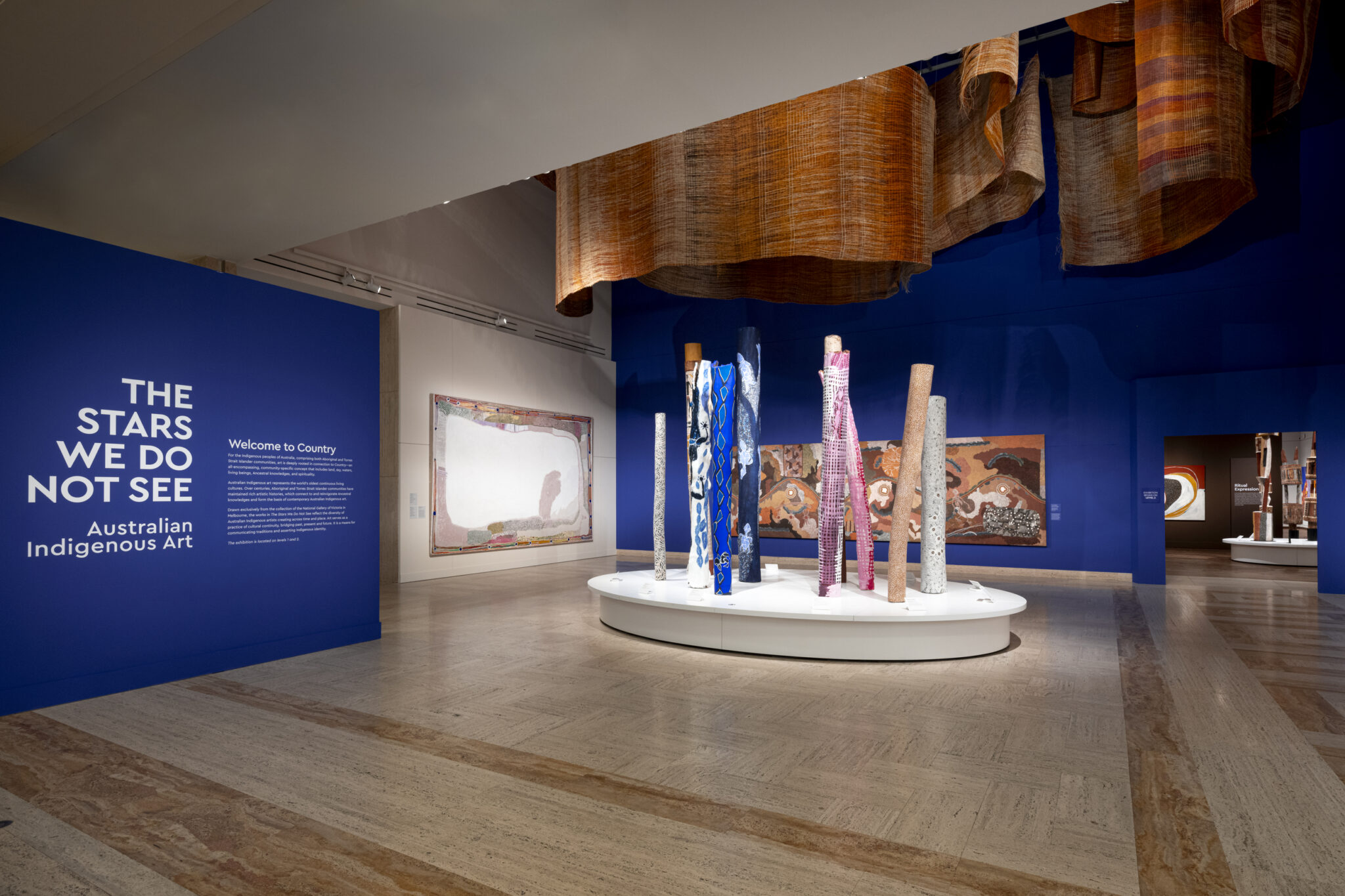
Portland Art Museum's first major international exhibition since its expanded campus opened in November 2025 fills the Schnitzer Sculpture Court with brightly painted logs, large-scale paintings and woven forms suspended from the ceiling.
"The Stars We Do Not See: Australian Indigenous Art," on view through Jan. 3, 2027, draws exclusively from the collection of Melbourne's National Gallery of Victoria.
Portland is the only West Coast stop for what the museum describes as the largest exhibition of Aboriginal and Torres Strait Islander art ever presented in North America, according to a PDX Pipeline listing citing the museum.
The show spans the late 19th century to the present. Visitors encounter ochre bark paintings, conceptual map paintings from the Central and Western Deserts, experimental weavings, neon works, video installations and photography.
Featured artists include Anmatyerr painter Emily Kam Kngwarray, Senior Yolŋu artist Gulumbu Yunupiŋu (after whom the exhibition is titled), and contemporary artists Brook Andrew, Destiny Deacon and Betty Muffler.
The exact scale depends on who's counting. The museum's exhibition page lists more than 100 works by more than 130 artists. PDX Pipeline puts the total at 147 works by more than 100 artists, several of whom work collaboratively.
Myles Russell-Cook curated the exhibition. Russell-Cook is the former senior curator of Australian and First Nations art at the National Gallery of Victoria and current artistic director and CEO of the Australian Centre for Contemporary Art. In Portland, Senior Curator of Native American Art Kathleen Ash-Milby coordinated the presentation. Before arriving here, the exhibition traveled through the National Gallery of Art in Washington, D.C. and the Denver Art Museum.
Reviewer Laurel Reed Pavic, writing for Oregon ArtsWatch, described the entrance as paying off with a forest of painted logs and ceiling-hung woven forms greeting visitors through the Rothko Pavilion hallway.
Pavic noted the show's organizational framework is deliberately non-chronological, with subsections like "Kimberley: Painting Country" and "Conceptual Maps" offering partial grounding rather than a single linear narrative.
Not every critic agreed on the approach. Washington Post critic Sebastian Smee, who reviewed the exhibition's earlier installation at the National Gallery of Art, called it "a crashing disappointment."
He argued the narrative was incoherent and too many lesser works diluted the impact of standout pieces. Pavic pushed back, suggesting the inclusive structure may reflect an Indigenous worldview that privileges collective knowledge over individual artists.
One work stood out for its unusual display. Charlotte Phillips Napurrula's painting "Kalipinypa" sits on a flat table, the only piece shown horizontally. A wall tag explains the display reflects how Napurrula painted on the ground, a practice shared by many artists in the exhibition.
The Portland Art Museum is at 1219 SW Park Ave. and is open Tuesday through Sunday. Admission is $27.50 for adults. Oct. 25 is a Miller Family Community Free Day with free admission. The museum also offers free admission on the first Thursday of each month.