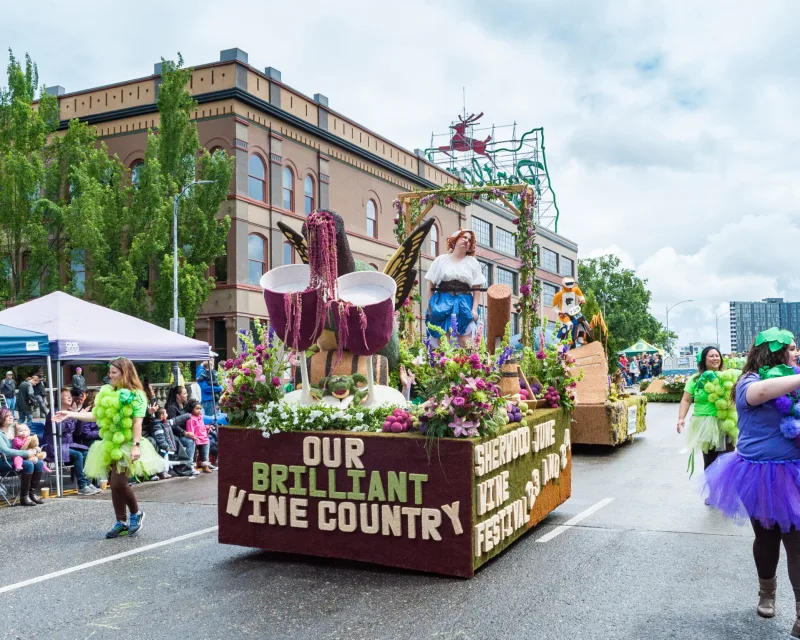
Portland's Rose Festival and Waterfront Blues Festival could shrink or vanish without lower permitting fees at Tom McCall Waterfront Park.
Portland Metro Chamber president and CEO Andrew Hoan made that warning to Mayor Keith Wilson in emails obtained by Willamette Week.
Wilson rejected a full fee waiver, offering instead a 50% parks permit discount for both festivals in 2026. He cited the city's $160 million general fund deficit.
"Given current budget constraints, a full waiver is not an option this year," Wilson wrote in a March 18 email to Hoan.
The two festivals together pay roughly $300,000 a year in parks permitting fees, according to Willamette Week. Without any discount, the Rose Festival alone would owe about $400,000, according to Steven Bledsoe, senior event strategist for the Portland Rose Festival Foundation.
With Wilson's 50% discount layered on top of an existing memorandum of understanding (MOU) that already cuts the Rose Festival's fees in half, the festival paid $100,000 in 2026.
That was not enough.
Bledsoe told Willamette Week the Rose Festival lost over $250,000 in revenue in 2026, running 20% below projections. Two major sponsors, Spirit Mountain Casino and Portland General Electric, dropped out. OPB reported in January that the festival combined its Grand Floral Parade and Starlight Parade into one event to cut costs.
CareOregon, one of the remaining premier sponsors, plans to reduce its spending in 2027.
The Waterfront Blues Festival faces similar pressure. Even with a 50% fee waiver in 2024, the festival paid $179,693 in parks fees, according to Willamette Week.
The festival pared down to two days in 2025 after costs soared, then returned to a three-day schedule in 2026 after the city waived 100% of fees in 2025.
Hoan and Wilson disagreed over whether the city had promised ongoing relief. Hoan wrote that fee relief was "a matter of upholding the city's prior commitments."
Wilson maintained the city had broken no promises and told Hoan to "pursue the appropriate legal channels" if the chamber disagreed.
Wilson's schedule phases out discounts: a 25% waiver in 2027, or 50% if attendance drops from the prior year, then no waivers at all in 2028.
The Rose Festival's existing MOU, which runs through 2027, would still apply on top of those figures.
The dispute plays out against a tight city budget. Wilson's proposed $8.5 billion budget for 2026 included a $13 million cut to the Parks Bureau and the elimination of 145 city jobs to close the general fund gap.
Tom McCall Waterfront Park has no permanent festival infrastructure. No concert bowl, no permanent stage, no shared storage for security fencing. Festivals haul everything in and haul it out again.
A state effort to help stalled. House Bill 2291, which would have created a grant program for waterfront festivals, failed in the Joint Ways and Means Committee.
The state did allocate $3 million through a 2025 spending bill to the Portland Metro Chamber's charitable arm. The chamber split $2.2 million in grants among the Rose, Blues and Winter Lights festivals.
A Portland State University study on alternative waterfront funding, commissioned with those funds, is not yet complete.
Renegotiation of the Rose Festival's MOU with the city begins in spring 2027.
The city has not announced a public comment process for those talks.