Two Portland city councilors are pushing to ban autonomous vehicles from city streets — citing surveillance and safety concerns — months after city officials warned that an unsuccessful Oregon bill would have allowed driverless cars without requiring cybersecurity protections.
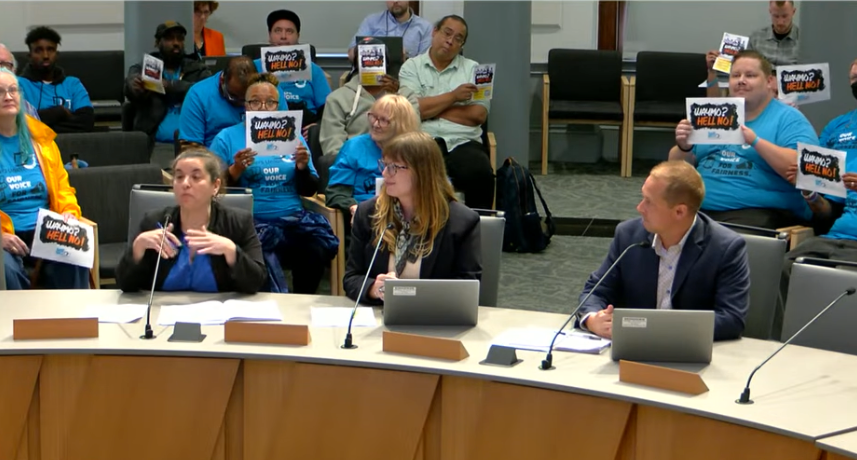
At the Oct. 27 Public Works Committee meeting, Sameer Kanal and Tiffany Koyama Lane presented a legislative concept citing surveillance, privacy, worker displacement, safety and accountability concerns. Their proposal would add prohibitions to city traffic code and direct city lobbyists to oppose state legislation overriding local authority.
“Do we want AVs in Portland?" Koyama Lane asked at the meeting. "I think for many of us that answer is no.”
Earlier this year, Portland's transportation bureau and the state's largest municipal group warned Oregon lawmakers that proposed autonomous vehicle legislation at the state level lacked any cybersecurity protections for the data these cars collect and transmit. The Portland Bureau of Transportation (PBOT) said in testimony submitted Feb. 9 that House Bill 4085 "stands silent on cybersecurity requirements."
PBOT Director Millicent Williams wrote that the Oregon Task Force on Autonomous Vehicles, which met in 2018 and 2019, had emphasized the importance of cybersecurity and privacy.
Williams said the city wanted "more clarity on the topic and integration of best practices Oregon should have in place to ensure adequate cybersecurity and privacy."
The League of Oregon Cities (LOC), which represents all 241 incorporated cities in the state, echoed that concern in its own Feb. 9 testimony.
Nicole Stingh, the league's legislative director, wrote that HB 4085 "does not include cybersecurity requirements as recommended by the Oregon Task Force on Autonomous Vehicles in 2019." The LOC said those protections should be statewide standards.
HB 4085 would have allowed autonomous vehicles to carry passengers, haul goods and operate as personally owned cars in Oregon. The bill died in the Transportation Committee during the 2026 short session after opposition from local governments and the Drivers Union, Street Roots reported.
Federal rule adds urgency
The cybersecurity gap flagged by Portland and the LOC exists alongside a separate federal action targeting foreign-linked vehicle technology. The U.S. Department of Commerce's Bureau of Industry and Security (BIS) issued a rule on Jan. 14, 2025, restricting the import and sale of connected vehicles and related hardware or software linked to China or Russia. According to the BIS overview, the agency determined companies from those countries "may be compelled to share data or allow remote access to connected vehicles in the United States."
The federal rule took effect March 17, 2025. It prohibits sales of covered software in vehicles starting with model year 2027 and bans imports of certain hardware starting with model year 2030.
Neither the PBOT nor LOC testimony specifically named Chinese or Russian technology as a concern in Oregon's AV framework. Their objections focused on the absence of any cybersecurity standards in the state bill.
Oregon's testing gap
Oregon does not currently regulate autonomous vehicle testing, according to the Oregon Department of Transportation (ODOT). The state relies on a voluntary notification process that lets ODOT share safety information about work zones and lane closures with companies testing on state roads. ODOT is the lead state agency on AV policy, a role assigned by House Bill 4063 in 2018.
The Task Force on Autonomous Vehicles, created by that same law and signed by then-Gov. Kate Brown on April 10, 2018, dissolved in January 2021. The packet does not detail what cybersecurity standards the Task Force recommended.
Portland building its own rules
With the state bill stalled, Portland is developing its own regulatory framework. PBOT staff presented an updated policy proposal to the City Council's Public Works Committee on Oct. 27, identifying safety, operations, managing change, and technology and privacy as priorities, KOIN reported.
District 4 Councilor Olivia Clark, who chairs the committee, said the city is not ready.
"I don't think that as a city we're really ready for these vehicles … and I'm afraid they're coming," Clark said, according to KOIN.
Williams wrote in her February testimony that the topic was "too complex for the constraints of the 2026 short session" and said she looked forward to continued discussions ahead of the 2027 legislative session, when Oregon lawmakers could take up a new AV bill.