Megan Becker couldn't see the crowds, but she could hear them.
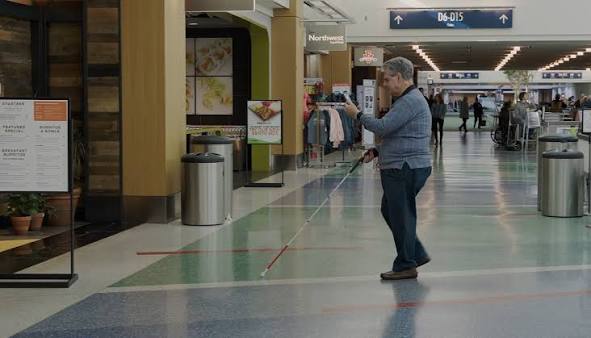
Blindfolded and gripping a white cane, the graduate student tapped her way through Portland International Airport on Wednesday, July 15, navigating from the terminal's sensory room to Henry's Tavern in Concourse C.
A walk that typically takes nine minutes took her 25.
Becker was one of eight Portland State University graduate students who spent the day at PDX learning firsthand what air travel demands of people who are blind or have low vision.
The exercise was one of the final assignments in a four-week course on navigation methods, led by Associate Professor Amy Parker, who coordinates PSU's Orientation and Mobility program.
The program trains future specialists who teach blind, visually impaired, and deaf-blind individuals to travel safely. It is one of only 12 such programs in the United States and the only one in the Pacific Northwest, according to the U.S. Orientation and Mobility Specialists Association.
Students used canes, human guides, and wayfinding apps GoodMaps and Aira to move through the terminal and clear TSA security while simulating vision loss.
The terminal's ambient noise layered over itself: chatter, construction, speaker announcements, alarms.
Jill McPherson, a Port of Portland terminal operations specialist, gave the group a presentation and tour of PDX's accessibility features, including hearing support systems, touch-screen maps, and a sensory room equipped with a mock airplane.
McPherson said the visit benefits airport staff, too: "This also gives our officers an opportunity to work with those that are blind or low vision or hearing impaired or deaf (and show) that they can still get their job done safely and really meet the needs of the guest."
Becker traveled more than 2,600 miles from Fayette County, West Virginia, to attend the program. She is her school district's only teacher of students with visual impairments and also serves as an adjunct professor at Marshall University.
Her exercise partner, Jasmine Lowe, is a K-12 teacher of students with visual impairments in Washington state.
Because so few programs exist nationally, PSU draws students from across the country. The hybrid model mixes online coursework with intensive in-person sessions in cities like Portland, Seattle, and Minneapolis.
Demand for qualified orientation and mobility professionals is high enough that students often secure jobs before graduating, according to the program's website.
Another student, Elika Kainoa, is visually impaired himself and had an O&M teacher growing up. He said that after three and a half weeks of practice in the program, he felt significantly more confident navigating unfamiliar environments.
Prior assignments in the course included navigating malls and crossing streets.
The airport visit capped the sequence with the most complex environment students had faced.
Parker told PSU in a 2025 profile that the program's purpose isn't to teach students to be blind: "It's to explore different ways of teaching so that they can be better teachers."